Scotland Yard
The A.B.C. MurdersScotland Yard coordinates the national response to the alphabetic murders, bringing together investigators and local forces while pursuing an expanding trail of letters, sightings, and practical leads. Its investigation is marked by a productive tension: public warnings and mass inquiry widen the search, but Hercule Poirot’s reasoning shows that the conspicuous pattern itself can obscure the individual crime it was designed to disguise.
Organization and investigative leadership
Scotland Yard enters the case through Chief Inspector Japp, an experienced investigator known to Hercule Poirot and Arthur Hastings. Japp’s visit revives the significance of the anonymous letter Poirot had received: the date it named is approaching, although the warning had temporarily slipped from Hastings’s mind. The institution’s role is thus established not only through official procedure but through an existing professional relationship with Poirot, whose private work becomes connected to the police inquiry.
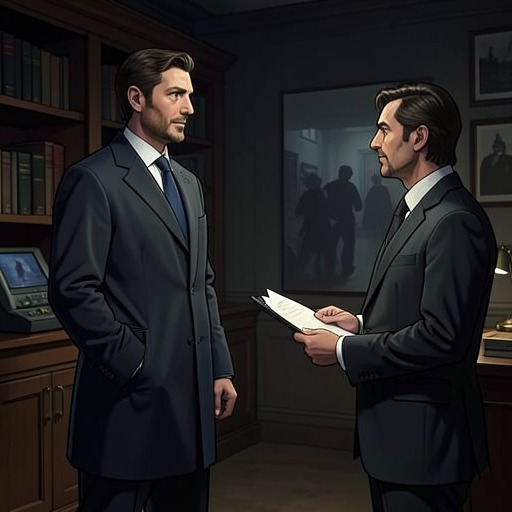
As the case grows, Scotland Yard participates in a conference that includes senior police officials, local officers, Japp, Inspector Crome, and Dr Thompson. The gathering compares the letters and establishes that two warnings are in the same handwriting. Their postmarks do not settle the question of where they were written: Poirot considers the Hampstead postmark of little importance. The conference illustrates the investigation’s division of labor, with national and local authorities pooling evidence while Poirot contributes interpretations that do not follow automatically from the documents’ most obvious details.
Inspector Crome is officially placed in charge of the case. Younger than Japp, he is presented as well educated and recently successful in tracking down a criminal responsible for a series of child murders. Hastings considers him capable, though too conscious of his own standing and somewhat patronizing toward Poirot. Crome’s authority gives the investigation a formal command structure, while his rivalry with Poirot creates friction over whose deductions deserve attention.
Public warning and the national search
Scotland Yard believes extensive publicity offers the best chance of catching the murderer. The Andover killing is publicly grouped with the other murders, newspapers circulate purported clues and photographs, and the case draws interviews and questions in Parliament. The Daily Flicker sharpens the appeal with the headline “HE MAY BE IN YOUR TOWN!” Poirot’s letters are published and reproduced, making him himself an object of public criticism and defense.
Public alarm is matched by practical work. Scotland Yard and the county police pursue even slight leads, questioning hotels, lodging houses, and boarding houses across a wide radius. They sift hundreds of reports from people who claim to have seen suspicious strangers, and check information involving trains, buses, trams, railway staff, bookstalls, and stationers. The search is deliberately broad: even vague accounts are verified rather than dismissed at once. This scale turns the population into a network of observers, but the volume and imagination of reported sightings also make assessment difficult.
Before the announced Doncaster murder, Crome describes the warning as ample time for a press campaign and a substantial deployment of police. The town is to be thoroughly alerted; people whose names begin with D are urged to be especially cautious, while officers are drafted in with the consent of chief constables across England. He expects police and civilians to join in the effort to catch one man. The operation shows how the alphabetical pattern directs resources and public attention toward a specific place, date, and category of potential victims.
Leads, witnesses, and verification
The inquiry depends on collecting accounts, but the novel repeatedly distinguishes a witness’s observation from what the witness later infers. At one shop, discussion produces several incompatible descriptions: four short, dark men have been noticed, while a shop-boy recalls a tall fair man and regrets that the stranger had no beard. The investigators leave without correcting the falsehoods they had used to prompt discussion. Such testimony offers possibilities, not a stable identification.
Crome’s questioning of witnesses exposes how recollection can be shaped by suggestion. Mr Leadbetter reconstructs an apparent stumble as a deliberate feint before the stabbing, but admits he heard no cry or groan; the groan belongs to his imagination. His description of the suspect then shifts toward a bald, sinister-looking giant, with uncertainty about whether the man was fair or dark. The account demonstrates why an apparently vivid statement cannot be treated as a direct, consistent record of what was seen.
Another witness, Mary Stroud, describes a medium-sized, stooping man in glasses, wearing a dark suit and a shabby Homburg hat. She can add little. Crome does not press her unduly, but has the telephone lines put to work; a practical detail survives the uncertainty of appearance, since the man had crossed the yard without a bag or suitcase. The contrast between elaborate but unstable descriptions and a small, checkable circumstance gives the inquiry its evidentiary texture.
Scotland Yard also follows Poirot’s suggestion to investigate the sale of stockings. Crome initially treats the idea with disdain, yet later reviews statements from the Churston case and finds an account by Hill, who had noticed a man talking to himself after leaving the Torquay Palladium. Hill recalls the man saying, “That’s an idea.” The film was Not a Sparrow, also showing at the Regal in Doncaster. Crome recognizes that the remark may connect an earlier sighting to the conception of the next crime’s method; the description is vague, but it links with accounts from Mary Stroud and Tom Hartigan. A lead that seemed inconsequential when first reported gains meaning through comparison across cases.
Procedure, limits, and the case’s solution
The institution’s search is not confined to public appeals or witness interviews. After Poirot’s theory about stocking sales is taken up at a conference attended by the Assistant Commissioner, Crome, and Hastings, Scotland Yard continues to test material leads against the case files. Crome’s review of statements, telephone inquiries, and cross-references shows investigation as cumulative work: the value of a clue may emerge only when separate accounts are brought together.
At the decisive confrontation, two Scotland Yard detectives emerge from the adjoining room, and Crome formally warns Franklin Clarke that anything he says may be used as evidence. The moment converts Poirot’s accusation into police action. Poirot’s explanation has identified the structural deception: the murderer created the appearance of a homicidal stranger and used the related killings to draw attention away from the individual murder. He reasons that an isolated killing is easiest to overlook when it is embedded in a series. Scotland Yard’s broad campaign has pursued the visible pattern; the solution depends on recognizing how that pattern itself conceals motive and opportunity.
The contrast does not reduce the police to passive observers. Scotland Yard supplies the organization, personnel, interviews, and verification that make the inquiry possible, while Poirot reframes what those accumulated facts mean. The result is a portrait of investigation as both surveillance and interpretation: more eyes produce more reports, but only careful comparison can distinguish observation from invention and a genuine clue from the noise surrounding it.